The Village Green as a Shared Place
The village green as a shared place brings neighbors together; learn how customs, local rules, and considerate planning help different uses coexist.
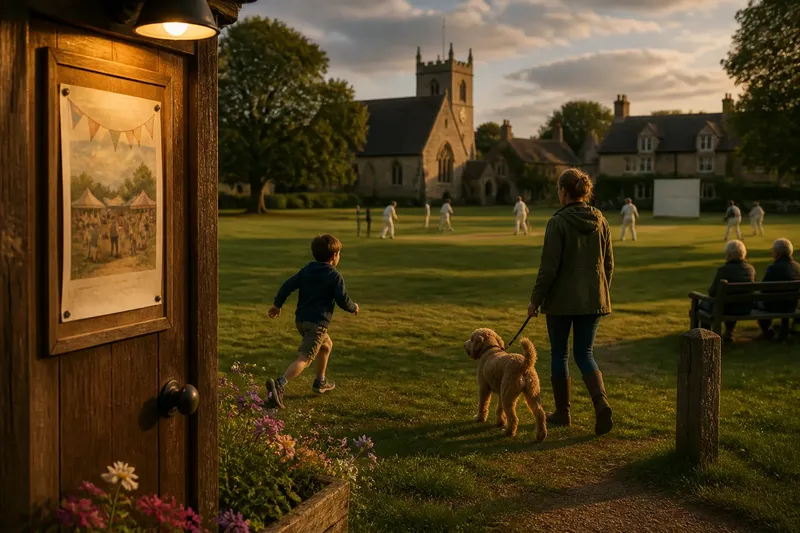
A child cuts across the grass as a dog walker gives a cricket match a wide berth, while a notice on the hall door announces a summer gathering. The village green as a shared place is not simply a tidy lawn: it is ground where different needs meet, sometimes comfortably and sometimes not.
There is no single shape or arrangement behind the name. A green might be a broad common in the village center, a small grassy space beside a road, or an open area bordered by houses and a church. Its appearance, ownership, and local customs vary. The useful starting point is to distinguish the general idea from the history and arrangements of a particular place.
A green is defined by shared use, not one fixed shape
In everyday speech, “village green” can describe a recognizable piece of open ground without settling questions of formal status or ownership. Some greens are publicly maintained; others have a more complicated history. Grass and open access alone do not tell a visitor who manages the land, what activities are permitted, or whether every use is unrestricted.
The word also carries a social meaning. A green can offer a place to pause, meet neighbors, watch an event, or hold a gathering. Those purposes may matter more to local identity than the exact boundary or the neatness of the turf. One village may have a war memorial or mature tree at its center; elsewhere, a cricket pitch, pond, or open expanse gives the place its character.
That variety matters when someone asks what a green is “for.” The answer may include uses that accumulated over time, rather than one original purpose preserved unchanged. Each green has to be understood on its own terms.
Older communal uses left room for changing needs
Historically, village greens and other shared open spaces could support practical community activities as well as recreation. People might gather livestock, meet for local business, or assemble for celebrations and public announcements. The mix depended on local custom, available land, and village routines; it was never a universal schedule followed identically everywhere.
As work and transport changed, some uses faded while others became more visible. A space once valued for everyday rural activity might later be associated mainly with a village fête, outdoor games, or a quiet place to sit. In another community, practical and ceremonial uses may still overlap. The ground can retain its communal meaning even after an activity that once made it useful has disappeared.
This continuity does not mean a green has remained untouched. Paths may shift, trees grow, and facilities appear or vanish. Residents adapt the space to current needs while keeping familiar customs: an annual gathering may hold its place even as its stalls and activities change.
Shared ground makes small conflicts visible
When several groups rely on the same open space, disagreements are unsurprising. A ball game may interrupt a quiet visit; a dog may disturb a formal event; a temporary stall may block a well-used path. Often the difficulty is not that someone objects to community life, but that people have different expectations about which use takes priority and when.
Another source of friction is the assumption that “shared” means “anything goes.” A green may be open to the public yet still have rules about vehicles, commercial activity, fires, sports equipment, or events. A familiar custom may be tolerated locally without being an automatic right. Signs, a parish or town council, a local trust, or the land manager can clarify arrangements. Rules depend on the place and applicable local requirements.
For visitors, a considerate first move is simple: look for notices and observe how the space is being used. If an activity would occupy a substantial area or bring equipment, ask the responsible local body before treating the green as an event venue.
What should you check before using a village green?
Does public access allow an organized event?
Public access does not necessarily include every proposed use. Check posted rules and contact the responsible local body about permission before arranging stalls, amplified sound, vehicles, or a gathering that takes over part of the green.
Why do residents disagree about what the green is for?
Different generations and groups may remember different customary uses, while newer activities compete for the same space. A conversation about timing, location, and access can clarify whether the concern is the activity itself or how it is arranged.
Why is the grass or path worn in one particular area?
Repeated foot traffic, informal shortcuts, games, or weather can concentrate wear. Notice where people naturally cross, then consider whether a marked route or temporary adjustment would ease pressure without shifting the problem elsewhere.
How can you tell whether an open lawn is a village green?
Several kinds of open ground look similar, but appearance does not establish a place’s name, ownership, or customary use. Ask locally or consult reliable council information rather than assuming every central grassy space has the same status.
Small adjustments can help different uses fit together
When a recurring conflict appears, begin with the specific pinch point. If a weekly game blocks the path to a bench, moving the playing area may help more than arguing over whether games belong on the green at all. If a gathering leaves litter, plan for waste and cleanup rather than treating that one problem as a reason to abandon the event.
Imagine a village group planning a small craft-and-produce gathering beside the green’s usual walking route. The invented starting point is a route used by walkers that would be partly blocked by tables. The group contacts the local body responsible for the space, asks what arrangements apply, and places tables away from the busiest crossing while leaving a clear route to the benches. The expected observable result is that walkers can continue through and visitors can browse without weaving between stalls. The tradeoff is that organizers have less room for tables, but they avoid obstructing the main route.
For another planned use, check these concrete details and choose an action based on what you observe:
- Check the noticeboard for restrictions on events; if it names a contact or permission process, follow it, but if it gives no guidance, ask the council or land manager.
- Check whether the proposed area overlaps a path; if it does, move equipment away from the route, but if it does not, keep the arrangement visible so walkers can pass.
- Check whether vehicles are mentioned in local rules; if they are restricted, arrange to unload elsewhere, but if the rules are unclear, ask before bringing a vehicle onto the green.
- Check whether the activity needs stalls or temporary structures; if it does, seek approval for their placement, but if it does not, keep the use within the space already available.
- Check whether a regular game or gathering already uses the area at the planned time; if it does, choose another time or location, but if it does not, tell nearby users where the activity will take place.
- Check how litter and leftover materials will be handled; if there is no clear cleanup plan, assign someone to carry waste away, but if a suitable disposal arrangement is available, make sure participants know where it is.
That kind of adjustment works best when organizers make the arrangement visible. A notice can explain where an event is taking place, how long it lasts, and which route remains open. For informal activities, a friendly request between users may be enough; for recurring or larger events, an agreed plan avoids leaving expectations to guesswork.
There is no need to turn every ordinary use into a formal booking. Match the response to the scale of the activity and the actual concern. A few people sitting beneath a tree call for a different approach from a gathering that brings vehicles, temporary structures, or a large crowd.
Customs keep a green recognizable without freezing it
Local traditions give a green a rhythm. A seasonal fête, a commemorative gathering, or an informal sports match can make the open ground feel like a shared landmark rather than leftover space between buildings. Such customs are sustained by the people who organize, attend, maintain, and explain them—not by the grass alone.
Tradition can also make room for newcomers. A long-running event need not be treated as private simply because residents know its routines; clear invitations and practical information help others participate respectfully. Welcoming new uses does not require dismissing memories attached to older ones. Listening to both can help a community decide what deserves to continue and what needs to change.
Care matters in the everyday details. Taking litter away, keeping access clear, respecting notices, and leaving room for people who use the space differently all reinforce the sense that the green belongs to a community rather than a single group.
Read each green through its own local story
A useful way to understand a village green is to ask who looks after it, what people commonly do there, and which local customs shape those uses. A noticeboard, a conversation with a parish council member, or a local history group may help answer those questions. Older residents can recall changes, while current organizers can explain how the space works now.
Keep the distinction between memory and permission in view. Someone may recall a long-standing activity without being able to confirm today’s rules, and an official notice may describe formal arrangements without capturing every informal custom. Together, local knowledge and current guidance offer a fuller picture than either alone.
The village green as a shared place is best understood as a living arrangement: open ground shaped by practical needs, customs, and decisions about making room for one another. When a new event or everyday use raises questions, start with that particular green, its responsible local contacts, and the people already using it. A quick look at the noticeboard before setting out equipment can prevent a small misunderstanding from becoming a larger dispute.