A Field Gate or a Stile? Choosing a Countryside Crossing
Compare a field gate and stile, check the path and footing, and choose a countryside crossing that suits your group while respecting farm boundaries.
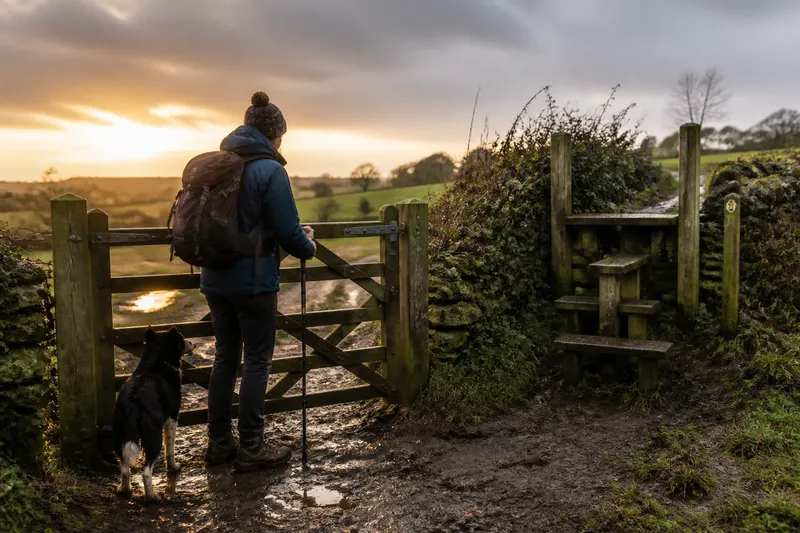
You reach a muddy field edge where a wooden gate opens onto a farm track and a stile stands a little way along the hedge. Choosing between a field gate and a stile starts with knowing which path is public, what the crossing demands, and how to pass without disturbing the farm’s daily work.
A field gate marks a working opening
A field gate creates a broad opening in a fence or hedge. Farm vehicles and livestock may use it, as well as walkers on a public path. Its size tells you little about access rights: a gate can lead to a private yard just as easily as to a marked footpath.
Check for a waymark, path sign, or reliable map before passing through. If the route is public and you open the gate, close it again unless a sign or clear instruction says otherwise. A latch may be stiff, and the gate can swing into animals or another walker, so move it carefully.
The ground beyond the gate offers another clue about the walk. A broad, churned track may continue beside working fields, but it is not an invitation to leave the marked route. Follow the waymarks rather than the most convenient-looking opening.
A stile keeps a boundary narrow
A stile allows walkers across a boundary while limiting the opening for livestock. Some have wooden steps over a fence; others use a ladder-like arrangement or steps built into a stone wall. The exact design varies with the hedge, wall, and local farm practice.
Before climbing, look for loose boards, wet timber, overgrown steps, or an awkward landing. A stile can be difficult with a backpack, walking poles, or a dog, even when it is sound. If you cannot cross without strain or risk, do not force it; look for another public route.
After crossing, pause to find the next waymark or the continuation of the path. A stile marks a boundary, not necessarily the direction of travel.
Choose a crossing by checking the whole route
A gate may suit someone who finds climbing difficult, but it can still open onto steep, muddy ground. A stile-free route may avoid climbing while including narrow bridges or rough surfaces. Check the complete journey, not just the obstacle at the field edge.
Use a current map and local path information, especially if you need a level route or are walking with a pushchair. If a route’s status or access arrangements are unclear, ask the relevant local authority or land manager before setting out.
Say you are planning a walk with a friend who uses a walking stick. Your starting information is a local map showing two public routes between the same lanes: one marked with several stiles, the other a bridleway. First, choose the bridleway as the option with fewer climbing obstacles. Next, check its surface and gradients with local path information. If those details appear manageable, use that route; if they do not, choose a different mapped path. The resulting tradeoff is fewer stiles in exchange for checking whether the bridleway’s ground suits your friend.
What should I check at a field crossing?
Use these observations to decide whether to cross as planned, adjust how you cross, or take another public route.
- Path signs and waymarks: Check that a sign or map confirms the route. If the route is clear, follow it; if not, do not treat an open gate as permission and check the path information.
- Gate and latch: Check whether the gate opens freely and whether a sign gives instructions. If it moves safely, pass through and leave it as directed; if it is stuck or damaged, do not force it and use another public crossing.
- Livestock: Look for animals near the crossing and read any posted directions. If the way is clear, pass calmly with your dog controlled; if animals crowd the opening, wait or take another route.
- Footing and landing: Check for mud, loose stones, wet timber, or a drop beyond the boundary. If you have secure footing, cross carefully; if the landing looks unsafe, turn back or find another public path.
- Room for your group: Check whether companions, children, and dogs can wait without blocking the path. If everyone can pass one at a time, proceed in turn; if the space is cramped, take a route with a more suitable crossing.
- Damage to a stile or gate: Look for broken steps, loose rails, or a failing latch. If the structure appears sound, use it gently; if it is damaged, avoid climbing or forcing it and report the problem to the local path authority where appropriate.
A quiet pause at the boundary can prevent a rushed crossing and keep the route clear for others.
Dogs and walking equipment need room
A narrow stile can be awkward for a dog, and a long lead may catch on wire or rails. Keep the lead controlled and make sure the landing area is clear before the dog follows. Do not lift an animal unless you can do so safely and the crossing allows it; if the space is too tight, use another public route.
Walking poles can snag on a latch or step. Fold or hold them securely before crossing, and keep them out of the way of the person behind you. At a gate, guide the opening rather than letting it swing; at a stile, wait until the person ahead has reached the far side.
Which field crossing questions matter before you go?
Does an open gate mean the path is public?
No. The gate’s position does not establish a right of way. Confirm the route on a reliable map or with local path information, and stay on the public path.
Is a stile always harder than a gate?
Not for every walker: a gate may be heavy or difficult to latch, while a stile requires climbing and balance. Check the actual structure and the needs of your group before choosing a route.
What should I do if livestock are near the crossing?
Give animals space, keep a dog under control, and follow any posted instructions. If the animals block the route or you feel unsure about passing, wait or choose another public path.
What if the gate or stile is damaged?
Do not force a stuck gate or climb a broken stile. Turn back or use another public route, then report the issue to the local path authority if appropriate.
Field crossings trace the working landscape
Gates and stiles show how paths fit around hedgerows, walls, livestock, and farm work. A gate leaves room for a wider flow through the boundary; a stile keeps the opening smaller while allowing walkers to continue. Their placement can help you read the lines between fields, farm tracks, and village lanes.
For a field gate or stile, confirm the path, check the footing, and consider what each person in your group can manage. If the crossing or route does not suit the walk, choose another public way rather than forcing your passage.