When a Place Name Misleads
Place names can hint at local history, but careful reading helps you separate a tempting guess from evidence about a settlement or its landscape.
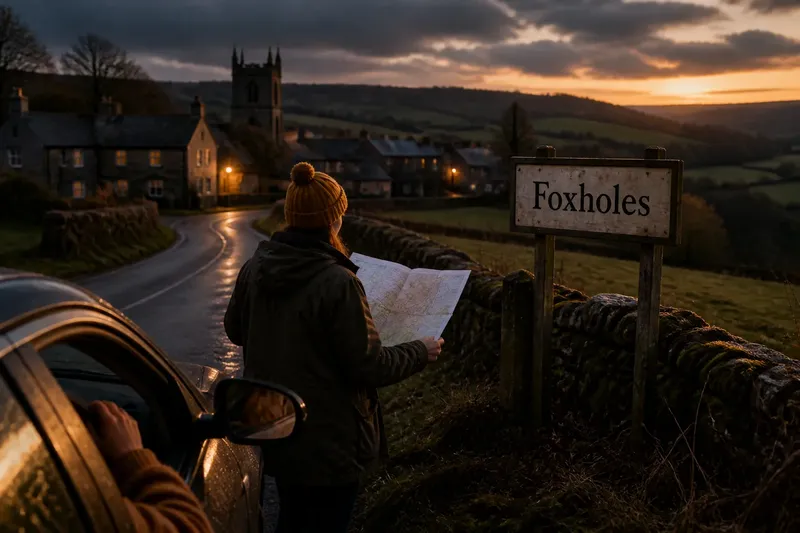
A sign at the edge of a village says “Foxholes,” and someone in the car asks if foxes once lived in burrows there. Place names invite that kind of quick guess: familiar sounds seem to point toward a clear story. But a name alone cannot establish a settlement’s history or landscape. Reading it carefully means treating its clues as questions, not answers.
Here are seven ways a place name can mislead, and how to keep curiosity from turning into certainty.
1. A familiar sound may belong to a different word
Names are spoken and written across generations, and their sounds can shift. A modern spelling may resemble an everyday English word even if the older form came from a different word, language, or pronunciation. The resemblance may be real as a sound and irrelevant as an explanation.
Take a name that sounds like “Beech End.” It is tempting to imagine a settlement beside a stand of beech trees, especially if a few beech trees grow nearby. Yet the resemblance does not tell you whether the name originally referred to trees, a person, a boundary, or something whose older form has changed. The local trees may make the guess feel vivid without making it more reliable.
When you hear a name aloud, jot down the spelling from a sign or map rather than relying on memory. Then keep the sound-alike explanation in pencil.
2. A modern spelling can conceal older forms
Place names have often been written by people who were recording what they heard, using spelling habits that differed from current ones. A name may appear in variant forms on older maps, parish records, or local documents. Those spellings can help explain how the present form developed, but a single variant is not automatically the original or the most meaningful one.
Look for a sequence of forms from sources connected to the same place, and note who created each source and for what purpose. A map label, a legal record, and a local account may preserve different spellings because they were made in different settings. If the forms disagree, that is a reason to keep the explanation open, not to choose whichever version best fits a favorite story.
Compare spellings before attaching a neat meaning to the modern one.
3. Familiar name elements can have more than one sense
Many place names contain recurring elements that look easy to translate. Words associated with a stream, a clearing, a hill, a dwelling, or a boundary can appear in names across the countryside. Their meaning may depend on the language and period involved, and a familiar-looking element can have more than one interpretation.
A name ending in “-ford,” for instance, may encourage a picture of a crossing. That can be a useful question to investigate, but the element does not identify a surviving ford, tell you where it lay, or prove that the crossing shaped the settlement’s growth. The name might preserve a feature that has changed, or its form may be less straightforward than it first appears.
Consult a reliable place-name reference when you want to explore an element’s possible meanings. Treat broad word lists as starting points rather than translations of a whole village name.
4. A landscape today is not a map of the past
A name that seems to refer to water, woodland, marsh, or open ground can tempt a visitor to match it to the visible scenery. But landscapes change. Streams can shift course, ponds can disappear, woods can be cleared or planted, and fields can be divided or joined. A place name may preserve an older feature that no longer stands out on the ground.
The reverse can happen too: a present-day feature may seem to confirm a name even if the connection is coincidental. Imagine you visit a hamlet called “Millbrook” and see a small stream beside the road. It is reasonable to wonder whether a mill once used that water, but the stream alone cannot establish that one existed or locate its site. The name, local records, older maps, and visible remains would need to be considered together.
Use the landscape to form questions, not to certify a name’s meaning.
5. A name does not reveal who named a place
A place name can preserve the influence of different languages, communities, landholders, or administrative habits. That does not mean every element can be assigned confidently to a particular group or person. Names can be borrowed, adapted, shortened, or reshaped as people use them, and a later written form may obscure those changes.
Be cautious with explanations that identify a single founder or event from the name alone. A name that resembles a personal name might indeed have a connection to someone, but resemblance is not a record of ownership or settlement. Look for independent local evidence before attaching a named individual or community to the story.
It is often more accurate to describe an interpretation as possible than to turn it into a claim about who lived there.
6. A local story and a word origin answer different questions
Residents may tell a story explaining why a place has its name. Such accounts are part of local culture and can reveal what a community remembers, values, or enjoys repeating. They do not always explain how the name first arose. A story may have developed after the name was already in use, perhaps because its sound invited a memorable interpretation.
That distinction does not make the story worthless. It helps you describe it fairly: “A local tale links the name to…” says something different from “The name comes from…”. If you are speaking with residents, ask how they learned the story and whether they know of other versions. Listen without treating one person’s account as a complete record of local opinion.
Keep the cultural value of a story separate from proof of a word’s origin.
7. A plausible explanation is not the same as a supported one
The most satisfying explanation is often the one that fits what you can see. A hill, an old church, a stream, or a cluster of farm buildings can make a name seem obvious. Yet several interpretations may fit the same sound, and a coherent story can still rest on a guess. The useful question is not only “Could this be true?” but “What evidence would help distinguish it from other possibilities?”
For a first check, compare the name’s spellings on maps from different periods, consult a reputable place-name dictionary or county history, and look for relevant records in a local archive or library. A local history group may point you toward useful material, though its account should be weighed alongside documentary evidence. Make a note of what each source actually supports, rather than combining clues into a firmer claim than any one of them allows.
Say you are writing a caption for a walk near a place called “Whitefield.” You might have heard that the name refers to pale soil, while an old map shows a farm with a similar name nearby. A careful caption could say that the origin is uncertain and mention the proposed soil connection only as an interpretation, unless a dependable source supports it more clearly. That wording still gives readers something to wonder about without pretending the map settled the question.
What can a place name tell you, and what evidence helps answer?
A place name can suggest lines of inquiry: an older landscape feature, a word borrowed from another language, or a local tradition attached to the sound. It cannot, by itself, settle which explanation is right. The practical task is to compare the name’s forms with sources that can support or challenge each possibility.
Can a place name prove what the land looked like?
No. It may preserve a clue about a feature, but the landscape could have changed, and the apparent meaning may be mistaken. Use maps, records, and local sources to investigate the possibility.
Are sound-alike explanations always wrong?
No, but resemblance by itself is weak evidence. An explanation becomes more convincing when older forms and trustworthy sources support the connection.
Should a local legend be included in a place-name account?
It can be, if you identify it as a local story rather than established word history. That lets readers appreciate the tradition without confusing it with a documented origin.
Where can you check an uncertain name?
Try a specialist place-name reference, older maps, local history publications, and relevant archive or library collections. Compare sources and state uncertainty plainly when they do not settle the question.
When a place name misleads, the problem is rarely the name itself; it is the confidence we lend to a quick interpretation. Keep the spelling, the sound, the landscape, and the local story distinct as you investigate, and the name becomes more interesting, not less. A careful question can preserve both the mystery of a village and the value of the evidence that may eventually explain it.